Apr 15, 2006

Still Gone For Go


This report out of The Guardian proves little if anything but it sure as heck doesn't contradict our longheld assertion that a decision to smash Iran in one way or another is a fait accompli. Even we at SMC are quite surprised at how tightly the Crazies have stuck to the choreography in their preparations for this pending summer war. Still on for June!
British officers took part in a US war game aimed at preparing for a possible invasion of Iran, despite repeated claims by the foreign secretary, Jack Straw, that a military strike against Iran is inconceivable.

The war game, codenamed Hotspur 2004, took place at the US base of Fort Belvoir in Virginia in July 2004.


...And some relevant video courtesy C&L

Apr 11, 2006

Let's Roll With Effwit - Flight 93

(I)t looks like the taped evidence of the Flight 93 "Let's Roll" myth will not be released to the public after it (or a plausible facsimile) is played to the jury in the Moussaoui sentencing trial.

The government was never going to release the tape itself. The myth of the brave Flight 93 passengers was concocted specifically to divert attention from the fact that the U.S. military shot down the airliner on the instruction of Vice-President Cheney.

Get the whole post over at Effwit!

A View For To Kill


Just because one's tenets are the result of wild speculation, that doesn't necessarily imply they aren't close enough to being worryingly true. Nevertheless, Genocide George has denied nothing in Hersh's report. However, ol Sy ain't speculating and his report is in line with what we already know - Iran is a foregone conclusion as part of a general sewing up of the Middle East and Centeral Asia into our fold of fistable influence. Added to that, the Israelis have been promised unobstructed views stretching to western Afghanistan and that promise was easy enough to make given our petrostrategic designs.

Ask yourself - who was way ahead of the pack when it came to reporting on the war crimes being systematically committed at Abu Graib? Sy be our guy!


President Bush dismissed yesterday talk of military action against Iran as "wild speculation" and emphasized that his doctrine of preempting threats does not necessarily mean the United States has to use force to stop other countries from developing weapons of mass destruction.

Apr 10, 2006

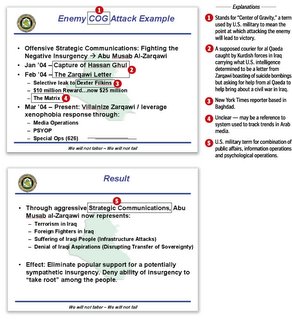
Zarqawi Emphasis in Info-Op MATRIX Exposed


Information operations, one of the core proficiencies of which regular readers of this blog have become expert, are the subject of a front page article in today's Washington Post.

Or, to be more specific, one aspect of the info-op MATRIX, that we have been studying.

The U.S. military is conducting a propaganda campaign to magnify the role of the leader of al-Qaeda in Iraq, according to internal military documents and officers familiar with the program. The effort has raised his profile in a way that some military intelligence officials believe may have overstated his importance and helped the Bush administration tie the war to the organization responsible for the Sept. 11, 2001, attacks...

For the past two years, U.S. military leaders have been using Iraqi media and other outlets in Baghdad to publicize Zarqawi's role in the insurgency. The documents explicitly list the "U.S. Home Audience" as one of the targets of a broader propaganda campaign.

Some senior intelligence officers believe Zarqawi's role may have been overemphasized by the propaganda campaign, which has included leaflets, radio and television broadcasts, Internet postings and at least one leak to an American journalist.

Listen to the understatement of the year:

The military's propaganda program largely has been aimed at Iraqis, but seems to have spilled over into the U.S. media. One briefing slide about U.S. "strategic communications" in Iraq, prepared for Army Gen. George W. Casey Jr., the top U.S. commander in Iraq, describes the "home audience" as one of six major targets of the American side of the war.

That slide, created by Casey's subordinates, does not specifically state that U.S. citizens were being targeted by the effort, but other sections of the briefings indicate that there were direct military efforts to use the U.S. media to affect views of the war. One slide in the same briefing, for example, noted that a "selective leak" about Zarqawi was made to Dexter Filkins, a New York Times reporter based in Baghdad. Filkins's resulting article, about a letter supposedly written by Zarqawi and boasting of suicide attacks in Iraq, ran on the Times front page on Feb. 9, 2004.

Leaks to reporters from U.S. officials in Iraq are common, but official evidence of a propaganda operation using an American reporter is rare.

Pure WaPo bullshittery here. But I guess their loophole is the term "official evidence", which in this case takes the form of a two images from a MNF-Iraq briefing slideshow.

Regulars here will get a chuckle from explanation number four.

U.S. military policy is not to aim psychological operations at Americans, said Army Col. James A. Treadwell, who commanded the U.S. military psyops unit in Iraq in 2003. "It is ingrained in U.S.: You don't psyop Americans. We just don't do it," said Treadwell. He said he left Iraq before the Zarqawi program began but was later told about it.

Again, one must refer back to explanation number four from the briefing slideshow for clarification (however opaque for non-regulars here).

With satellite television, e-mail and the Internet, it is impossible to prevent some carryover from propaganda campaigns overseas into the U.S. media, said Treadwell, who is now director of a new project at the U.S. Special Operations Command that focuses on "trans-regional" media issues. Such carryover is "not blowback, it's bleed-over," he said. "There's always going to be a certain amount of bleed-over with the global information environment."

Ho ho ho.

One internal briefing, produced by the U.S. military headquarters in Iraq, said that Kimmitt had concluded that, "The Zarqawi PSYOP program is the most successful information campaign to date."...

Kimmitt said, "There was clearly an information campaign to raise the public awareness of who Zarqawi was, primarily for the Iraqi audience but also with the international audience."

Interesting isn't it, the many instances that the U.S. television and print media blithely referred to Al Qaeda operating in Iraq. This "bleed-over" (sic) was done to intentionally conflate Zarqawi's group with the real Al Qaeda of Osama bin Laden, in order to tie Iraq to 9-11 in the minds of Americans--thus justifying the (by then failing) U.S. war in Iraq.

Brokeback Prophets

Leave it to the false prophets to let their greed and ambition get in the way of propagating their impious messages. Many minions are needed by the Devil when minions like these fall so easily - and seemingly without fail by their own hand. Guess the Beast will have to wait

The once-mighty Christian Coalition, founded 17 years ago by the Rev. Pat Robertson as the political fundraising and lobbying engine of the Christian right, is more than $2 million in debt, beset by creditors' lawsuits and struggling to hold on to some of its state chapters.

At its peak a decade ago, the Christian Coalition deployed a dozen lobbyists on Capitol Hill. Today, it has a single Washington employee who works out of his home. Its phone number with a 202 area code is automatically forwarded to a small office in Charleston, S.C.

Apr 8, 2006

Red Horses Of The Chariot


A new piece by Seymour Hersh in the New Yorker says that President Bush is so adamant about denying Iran the ability to develop nuclear weapons that serious plans are being made to pre-emptively nuke that Persian Gulf nation.

A government consultant with close ties to the civilian leadership in the Pentagon said that Bush was "“absolutely convinced that Iran is going to get the bomb" if it is not stopped. He said that the President believes that he must do "what no Democrat or Republican, if elected in the future, would have the courage to do,"” and "“that saving Iran is going to be his legacy."...

In recent weeks, the President has quietly initiated a series of talks on plans for Iran with a few key senators and members of Congress, including at least one Democrat. A senior member of the House Appropriations Committee, who did not take part in the meetings but has discussed their content with his colleagues, told me that there had been "“no formal briefings," because "“they're reluctant to brief the minority. They're doing the Senate, somewhat selectively."


The House member said that no one in the meetings "“is really objecting"” to the talk of war. "“The people they'’re briefing are the same ones who led the charge on Iraq. At most, questions are raised: How are you going to hit all the sites at once? How are you going to get deep enough?" (Iran is building facilities underground.) "“There'’s no pressure from Congress"” not to take military action, the House member added. "“The only political pressure is from the guys who want to do it." Speaking of President Bush, the House member said, "“The most worrisome thing is that this guy has a messianic vision."” ...


One of the military'’s initial option plans, as presented to the White House by the Pentagon this winter, calls for the use of a bunker-buster tactical nuclear weapon, such as the B61-11, against underground nuclear sites...


According to a former senior intelligence official:

"These politicians don'’t have a clue, and whenever anybody tries to get it out"--—remove the nuclear option--"they're shouted down."

The attention given to the nuclear option has created serious misgivings inside the offices of the Joint Chiefs of Staff, he added, and some officers have talked about resigning. Late this winter, the Joint Chiefs of Staff sought to remove the nuclear option from the evolving war plans for Iran--—without success, the former intelligence official said. "“The White House said, '‘Why are you challenging this? The option came from you.'"” ...


(A Pentagon advisor) also confirmed that some senior officers and officials were considering resigning over the issue. "There are very strong sentiments within the military against brandishing nuclear weapons against other countries," the adviser told me. "“This goes to high levels."”


On this blog we have been reporting heavily on the information operation against Iran for months now. Someone may be feeding Hersh material along these lines.

If not, things are gonna get hairy real soon.

Apr 7, 2006

Nobel Laureate on Retardonomics

American Nobel Laureate Joseph Stiglitz did a recent Q&A session with German Spiegel Magazine. He discussed the $ 1 trillion cost of the Iraq war (compare that with Bush's $ 50 billion estimate - that's not just being 100% wrong. That's being 100% wrong 20 times over!) and other related goodies such as how Bush is helping Iran by driving up oil prices. Here are some excerpts:


Stiglitz:They thought they were going to walk in, everybody would say thank you, and they would set up a democratic government and leave. Now that this war is lasting so much longer, they constantly have to adapt their budget. It rose from $50 billion to $250 billion. Today, the Congressional Budget Office talks about $500 billion or more for this adventure. The(se) reported numbers do not even include the full budgetary costs to the government. And the budgetary costs are but a fraction of the costs to the economy as a whole. And compare this to Gulf War number one, where America almost made a profit!

This is not like a world war where you're attacked. We were attacked in Pearl Harbor, we had to respond. This time, we had a choice, we had to decide how and who we are going to attack ...


SPIEGEL: Bush would argue it's worth spending that much to decrease the probability of a major terrorist attack on the US.

Stiglitz: Nobody takes that seriously. Instead, most people think the Iraq war has increased the probability of an attack. However, it's difficult to put this aspect into financial terms.

SPIEGEL: How did you calculate the costs of the war?

Stiglitz: The official figures are only the tip of an enormous iceberg. For instance, one of the costs of the war is that soldiers today get very seriously injured but stay alive, and we can keep them alive but at an enormous price.

SPIEGEL: Is this the biggest item in your calculations?

Stiglitz: It's very important. The Bush administration has been doing everything it can to hide the huge number of returning veterans who are severely wounded -- 17,000 so far including roughly 20 percent with serious brain and head injuries. Even the estimate of $500 billion ignores the lifetime disability and healthcare costs that taxpayers will have to spend for years to come. And the administration isn't even generous with veterans, widows and their kids.

SPIEGEL: What does that mean?

Stiglitz: If you're injured in an automobile accident, and you sue the driver, you get much more for your injury than if you're fighting for your country. There's a double standard here. If you happen to put your life at risk fighting for your country, you get a little. If you walk across the street and get injured, you get a lot more. Similarly, payments for a dead soldier amount to only $500,000, which is far less than standard estimates of the lifetime economic cost of a death. This statistical value of a life in the US amounts to circa $6.5 million.

SPIEGEL: How much will a severely brain-damaged soldier cost the US government?

Stiglitz: My moderate estimate is about $4 million. For this group alone there will be a total cost of $35 billion that nobody is talking about. But look at the broader picture: The Veterans Administration originally projected that roughly 23,000 veterans returning from Iraq would seek medical care last year. But in June 2005, it revised this number to an estimated 103,000. No wonder the Veterans Administration had to appeal Congress for emergency funding of $1.5 billion last year.

SPIEGEL: If this is a $1 trillion war, why couldn't the US provide its soldiers with safer body armor and better protected vehicles?

STIGLITZ: Obviously, the US can afford to pay for body armor. Rumsfeld, our Secretary of Defense, said you have to fight with the armor you have, but that's unconscionable. The military is focusing only on the short run costs. If they don't provide appropriate body armor, they save some money today, but the healthcare cost is going to be the future for some other president down the line. I view that as both fiscally and morally irresponsible.

SPIEGEL: This war could have been both safer for the troops and cheaper for the country?

Stiglitz: Exactly.

SPIEGEL: Before the invasion of Iraq, the US administration said the best way to keep oil prices in check is a short and successful war. A barrel was at $25 at that time, and now it's over $60. What of this increase is due to Iraq?

Stiglitz: In our analysis about the cost of war, we only assumed a modest $5 to $10 caused by the war. We wanted to keep our study conservative, so no one would dispute our numbers, and no one did. But I believe that's a vast underestimation of the true cost.

SPIEGEL: But why? China and India are increasing their demand, real global growth has been going on. This is driving the prices.

Stiglitz: When demand rises so does supply -- that's how markets usually work. Now we're seeing that demand for oil is rising but we're not getting a commensurate increase in supply. And there's a simple answer, it's Iraq. But it's not just because it production has been down.

SPIEGEL: Why else?

Stiglitz: The Middle East is the lowest cost producer in the world. They can produce oil for $10, $15 or $20 a barrel. Now we have the technology to produce oil elsewhere for $35 to $45. But who wants to develop fields or invest in new technologies elsewhere if they know that in five years' time, the Middle East may be supplying oil at previous prices?

SPIEGEL: In other words, were peace and stability re-established in the Middle East, the oil price would be back to maybe $25, despite the huge global hunger for energy?

Stiglitz: Yes. By the way that's the price level oil traders were speculating on in futures trading before the outbreak of war.

SPIEGEL: There should be huge economic pressure on Bush to end this conflict.

Stiglitz: The only people benefiting in this war are Bush's friends in the oil industry. He has done the American economy and the global economy an enormous disfavor, but his Texan friends couldn't be happier. The price of oil is up, and they make money when the price of oil goes up. Their profits are at record levels.

SPIEGEL: What's your economic view on Iran?

Stiglitz: We are helping the people that Bush says are evil. Teheran couldn't be happier about the high oil prices resulting from the Iraq war.

SPIEGEL: If the UN Security Council votes for sanctions over Iran and its oil exports, what would that mean for the world economy?

Stiglitz: It would mean an enormous disruption, as oil prices might rise over $100. You can increase the price from $25 to $40, and people can absorb it. If the price rises above $60, they become unhappy. They start to adjust, they move to smaller cars, drive a little bit less. At $100 or $120, there are major changes in lifestyle. The sales of cars will plummet. Poor people will be facing real problems of heat versus food.

SPIEGEL: The world can't afford sanctions at this time?

Stiglitz: We talk about not allowing their officials to get visas to visit our countries.

SPIEGEL: That's not a harsh measure.

Stiglitz: It's no sanction. So the answer is, yes, we have no effective sanctions.

Outsourcing Torture: Air Enema

The following is a statement from Bill Goodman, CCR Legal Director:

"These new disclosures again demonstrate our contention that the U.S. government is systematically outsourcing torture. The flight records reveal a disturbing pattern of secret human rights abuse around the world, from the U.S. to Guantánamo Bay to Djibouti. It is shameful that the Bush Administration has used the CIA and private aircraft operators to send people abroad for torture, and now that these practices have been exposed, the Administration and these companies must be held accountable. Congress overwhelmingly voted to ban torture and the American people do not want torture practiced in their name - not on our soil, and not hidden in another country.

"Below the radar: Secret flights to torture and 'disappearance'" is available at Amnesty International's website.

Smoked & Choked - Flight 93

Effwit just keeps churning out interesting commentary on Flight 93. Here's a follow-up comment to the previous one.

Effwit said...

All the families know is what they heard on the tapes that were played to them a year or two ago. These tapes show no successful entry by the passengers into the cockpit--kinda scotching the heroic passengers bringing the plane down before it could be used on a Washington target.

The Flight 93 families were expressly told not to talk about what they heard on the tapes. Sworn to secrecy according to some of them. They still are emotionally (and financially, as you point out) tied to the "heroes" story.

That's all that any of the families know that differs from the official narrative. AFAIK.

The whole reason for the big payoff in the first place was to force the victim's families to sign away their rights to sue the government and the airlines.

No lawsuits, no discovery phase of a trial. Simplifies the cover-up enormously.

The malefactors weren't spending their money anyway. It was the taxpayers' dollars.

Apr 6, 2006

Revoked & Smoked - Flight 93

Speaking of Flight 93 (You do know your 911 incidents timeline, don't'ya?!). I'm posting an interesting comment from Effwit's blog.

Effwit said...
Yeah, I though it was too cute that they are emphasizing Flt. 93. They gotta be worried about the legality of the V.P.'s shootdown order.

The tape that they are going to play (if legit) will be truncated. I have been told that if the ANG smoked one of the engines with an A to A--which would be SOP in such a case--there would have been all sorts of audible alarms going off, and would be on the cockpit voice recorder.

The malefactors cannot afford the truth to come out. Now or ever.

Foregone Meatballs

Key players in the Bush administration think a military confrontation with Iran is unavoidable, leading to stepped up military planning for such a prospect, according to several experts and recently departed senior government officials.

Some of these observers stressed that military strikes against Iran are not imminent and speculated that the escalated war chatter could be a deliberate ploy to ratchet up diplomatic pressure on Tehran to abandon its nuclear ambitions. Still, they made clear, the tone in Washington has changed drastically.

"In recent months I have grown increasingly concerned that the administration has been giving thought to a heavy dose of air strikes against Iran's nuclear sector without giving enough weight to the possible ramifications of such action," said Wayne White, a former deputy director at the State Department's Bureau of Intelligence and Research.

Errrr... Negotiations aren't wanted nor have they ever been on this issue since, in terms of true urgency, it's a non-issue. We just want to seal the grand deal and coalesce Iran into our pax americana blanket of Middle Eastern and Central Asian resource control. Nothing particularly shocking or insightful about that unless you're one of those Kool-Aid quaffers that's green-housing your colon cancer with Wonder Bread and Cheez Whiz. The only ploy in this backshooting town is the pretexting info-op we have been bombarded with for the past 4 months.

Errrr... In recent months? Try in the recent decade, fat azz!. Time to get up and get out and get a new TV Guide and a barium high colonic.

Power Point For Crooks

I hate Power Point.

I don't trust anyone pitching me anything if they're pitching it with Power Point. But here I am, Power Point bull-shitting my way along to huckster my latest venture-cap wares to a consortium of PigCap punters. Even a truthteller can at times resort to graphic skullduggery to turn a buck or two when he can't shake the Geneve Car Salon out of his misogynist mind. But all this rambling is intended to be but a segue from his compulsive urge to post a babe-picture to informing you that M1 ain't back at SMC in any regular manner until Friday because of his Power Pointing shenanigans. Luckily the eagle-eyed Effwit has been fastidiously holding down the SMC fort against Genocide George and his band of quirky hairdo evil-doers.


I wonder how many times Power Point was deployed by Rumsfeld's cadre of prostate-bleeding deathskulls to pitch their particularly rushed approach to Iraq that so remarkably contravened the better wisdoms of all the State Dept., Intelligence community, and Pentagon experts on such invasive contingencies. I bet it was many a confabbing time.

Experience has taught me that whenever you find a 50+ suited geezer with a Power Point presentation, a laptop, and a projector (and God forbid a laser pointer!) - well, you will have found a shyster trying to get his grubby hand inside your shirt and on out through the fire exit before you can holler "Who the fuck stole my new pacemaker battery?!"

Head over to Effwit and PSD to keep up with all the crap in which we ourselves so love to bask in.

Apr 4, 2006

Iranian Weapon Roll-Out Continues

The nearly week-long display of military gimcracks by Iran is clear evidence that they are somewhat concerned about the possible intentions of the "Great Satan" as the U.S. is known in Ayatollah-speak.

Fearsome new weaponry is being introduced to the world stage at a fast and furious pace.

Iran successfully tested a "super-modern flying boat'' on Tuesday and the land-to-sea Kowsar missile that military analysts say is designed to sink ships in the Gulf, state media reported.

The tests came in the middle of Gulf war games that started on Friday. Iranian state radio said the Kowsar could evade radar and that its guidance system could not be scrambled.

The implied threat to oil tankers will not be taken lightly in Washington.

Iran rarely gives enough details of its military hardware for analysts to determine whether Tehran is making genuine advances or simply producing defiant propaganda while pressure ratchets up on its nuclear program.

Although Iran can draw on huge manpower, its naval and air-force technology is largely dismissed as obsolete.

The United States said it was possible Iran had developed weapons that could evade sonar and radar but warned the Islamic Republic had a tendency to "boast and exaggerate.''

Interesting in light of the acknowledged boastful and exaggerated claims by Iran that the U.S. media finds it newsworthy enough to prominently feature these reports of Iranian military developments. A cynic might see the dimmest outlines of an agenda in play.

The Revolutionary Guards, the elite branch of Iran's military, have been holding their maneuvers -- code-named the "Great Prophet" -- since Friday, touting what they call domestically built technological advances in their armed forces.

But some experts say it appears some of the technology has come from other countries, possibly Russia, and some experts also have questioned just how adept the missiles are at evading radar.

It is remarkable how seamlessly the anti-Russia info-op fits into the larger anti-Iran program. Synergies like this can enhance value in such an enterprise, credibility being the currency in psy-ops.

We will not have to wait long for the next installment in this saga, Iran plans to announce another new weapon, a missile, this afternoon.

Apr 3, 2006

This One's A "Hoot"

The Iranians are now acting out to such a degree that the grown-ups will soon be forced to spank them.

They announced yesterday that they have just tested an "underwater missile" ("torpedo" in non freedom-hating languages) that can-- get this-- "outpace an enemy warship."

Getting scared yet?

The new torpedo, called the "Hoot," or whale, could raise concerns over Iran's power in the Gulf, a vital corridor for oil supplies and where the U.S. Navy's 5th Fleet is based. During the Iran-Iraq war in the 1980s, Iranian ships attacked oil tankers in the Gulf, and Iran and the U.S. military engaged in clashes.

(Gen. Ali Fadavi of the country's elite Revolutionary Guards) said only one other country, Russia, had a missile that moved underwater as fast as the Iranian one, which he said had a speed of about 225 miles per hour. State television showed what it described as the missile being fired.

"The missile carries a very powerful warhead that enables it to operate against groups of warships and big submarines," he said.

Early intelligence reports indicate that it then goes "boom."

(Fadavi) contended that the boats that would launch the missile were able to evade detection systems but that "even if an enemy's warship sonar can detect the missile, no warship can escape from this missile because of its high speed."...

(Iran's representative to the atomic energy agency, Ali Asghar Soltanieh), told CNN on Sunday that he did not believe that the weapon could carry a nuclear warhead. "The world should not worry because any country has its own self-defense conventional military activities," he said.

Mr. Soltanieh is correct that the world should not worry about such trifles, but he clearly hasn't read the Mearsheimer/Walt report.

Apr 2, 2006

Iran May React To U.S. Attack With Terrorism

The anti-Iran info-op today gets into the deep seated fears that Americans have of Islamic terrorism. The front page of the Washington Post breathlessly tells us that Iran has been judged by the U.S. intelligence community to be likely to react to an attack on their nuclear program by unleashing terrorist operatives in Iraq and Europe.

As tensions increase between the United States and Iran, U.S. intelligence and terrorism experts say they believe Iran would respond to U.S. military strikes on its nuclear sites by deploying its intelligence operatives and Hezbollah teams to carry out terrorist attacks worldwide.

Iran would mount attacks against U.S. targets inside Iraq, where Iranian intelligence agents are already plentiful, predicted these experts. There is also a growing consensus that Iran's agents would target civilians in the United States, Europe and elsewhere, they said.


U.S. officials would not discuss what evidence they have indicating Iran would undertake terrorist action, but the matter "is consuming a lot of time" throughout the U.S. intelligence apparatus, one senior official said. "It's a huge issue," another said...


(T)errorism experts considered Iranian-backed or controlled groups -- namely the country's Ministry of Intelligence and Security operatives, its Revolutionary Guards and the Lebanon-based Hezbollah -- to be better organized, trained and equipped than the al-Qaeda network that carried out the Sept. 11, 2001, attacks.


The Iranian government views the Islamic Jihad, the name of Hezbollah's terrorist organization, "as an extension of their state. . . . operational teams could be deployed without a long period of preparation," said Ambassador Henry A. Crumpton, the State Department's coordinator for counterterrorism...


Government officials said their interest in Iran's intelligence services is not an indication that a military confrontation is imminent or likely, but rather a reflection of a decades-long adversarial relationship in which Iran's agents have worked secretly against U.S. interests, most recently in Iraq and Pakistan.


It is merely a coincidence that we are ramping up against the Iranian intelligence services and their proxies at a time when we are extremely stretched in that area elsewhere.

Former CIA terrorism analyst Paul R. Pillar said that any U.S. or Israeli airstrike on Iranian territory "would be regarded as an act of war" by Tehran, and that Iran would strike back with its terrorist groups. "There's no doubt in my mind about that. . . . Whether it's overseas at the hands of Hezbollah, in Iraq or possibly Europe, within the regime there would be pressure to take violent action."...

Iran's intelligence services "are well trained, fairly sophisticated and have been doing this for decades," said Crumpton, a former deputy of operations at the CIA's Counterterrorist Center. "They are still very capable. I don't see their capabilities as having diminished."...


The current state of Iran's intelligence apparatus is the subject of debate among experts. Some experts who spent their careers tracking the intelligence ministry's operatives describe them as deployed worldwide and easier to monitor than Hezbollah cells because they operate out of embassies and behave more like a traditional spy service such as the Soviet KGB.


You know that the Al-Qaeda link has to come up somewhere.

A report by the independent commission investigating the Sept. 11 attacks cited al-Qaeda's long-standing cooperation with the Iranian-backed Hezbollah on certain operations and said Osama bin Laden may have had a previously undisclosed role in the Khobar attack. Several al-Qaeda figures are reportedly under house arrest in Iran.

Others in the law enforcement and intelligence circles have been more dubious about cooperation between al-Qaeda and Hezbollah, largely because of the rivalries between Shiite and Sunni Muslims. Al-Qaeda adherents are Sunni Muslims; Hezbollah's are Shiites.


Under the logic (sic) of the illegal preventive war doctrine, the fears of Iranian retaliation to a U.S. attack being trumpeted today could be a trigger for an American first strike. At a minimum, today's fear-mongering will add to the laundry list of reasons justifying to the public our eventual strike on Iran.

Also today, the Washington Post goes with a lead editorial on the Iran nuclear issue, and why the nefarious Russians cannot be trusted to reliably advance the goals of U.S. policy toward the Islamic Republic. The anti-Russia info-op being an adjunct to the larger program against Iran.

If diplomacy is going to be effective, considerably greater pressure will have to be placed on a regime that has been riding a wave of radicalism.

Greater pressure through the Security Council will require, first of all, greater cooperation from Russia. Russian President Vladimir Putin so far has been the biggest winner in the diplomatic maneuvering. The Bush administration's hope that Mr. Putin will help explains why it has failed to react to Russian provocations in much of the rest of the world. So the first step toward a more effective Iran policy is to call Mr. Putin's bluff. If he does not share the interest of the other Group of Eight nations in punishing the Iranian leadership for its pursuit of nuclear weapons, then there should be no further reason to treat him as an ally. He should be asked for a decision before he hosts the G8 summit in St. Petersburg this summer.


The idea for threatening Russia with a boycotted G8 summit was first floated (from who's helpful tip?) by the odious Anne Applebaum on March 8 in the Post. See: Skip St. Petersburg, Mr. Bush.

The timeline for the attack against Iran, as evidenced by the sequence of inflammatory stories in the media is proceeding exactly as necessary to prepare the nation for a pre-election U.S. military strike.

Apr 1, 2006

Anti-Iran Info-Op Goes "Ballistic"

One never has to look too far to come upon scary news about the capabilities and intentions of Iran. A person who was inclined to believe in conspiracies could almost imagine a co-ordinated effort by nefarious parties to constantly trumpet sinister information about the reviled Islamic Republic.

Iran test-fired a new missile on Friday that it said could carry multiple warheads and evade radar systems.

The air force chief of the Revolutionary Guards, Brig. Gen. Hossein Salami, said the missile, the Fajr-3, was made in Iran with "very advanced" features.

It can carry several warheads, and "can also evade enemy's most sensitive radar systems," he told state television. "It can avoid antimissile missiles and strike the target."

A State Department spokesman, Adam Ereli, said Friday that the administration did not have any technical details about the missile, but that the test showed that Iran had "a very active and aggressive military program."

An Israeli missile expert quoted by Reuters expressed skepticism, however, saying Iran "could be bluffing."

When even Israel publicly questions a detail of the scare-mongering, that really says something.

The expert, Uzi Rubin, a former director of the Arrow missile defense program, said if it was true that Iran had such rockets, there was no way it could have produced them without outside help.

That's better, the missile has to be a product of the larger "Axis of the Freedom Haters."

The display of military force came two days after the United Nations Security Council demanded that Iran stop its nuclear enrichment program within one month. The foreign minister, Manouchehr Mottaki, brushed off the demand...

Iran started its arms program in 1980 when the war with Iraq broke out. Since 1992 Iran has produced its own tanks, armored personnel carriers, missiles and fighter planes.

This doesn't sound good. Since they are freedom haters (Muslims), can't we just declare that they have no right to produce weapons of any kind?

No? Well it was worth a shot.

The United States has expressly declared that it has adopted a "preventive war" doctrine, the questionable "we won't wait for them to hit us again" formulation. This next bit fits right in:

The Fajr-3, which means "victory" in Farsi, can reach Israel and U.S. bases in the Middle East, Iranian state media indicated. Gen. Hossein Salami, the air force chief of Iran's elite Revolutionary Guards, did not specify the missile's range, saying how far it can travel depends on the weight of its warheads.

But state-run television described the weapon as "ballistic" -- suggesting it has a range comparable to that of Iran's existing ballistic rocket, which can travel about 1,200 miles and reach arch-foe Israel and U.S. bases in Iraq and the Persian Gulf region.

The U.S. Air Force is probably getting ready to deploy the B-52s to Diego Garcia any day now.